 Tooth Calendar Blog
When to Check Wisdom Teeth: Mid-to-Late Teen Checkups and Removal Decisions
Wisdom teeth usually come in at 17 to 21. If needed, an X-ray at a mid-to-late teen checkup can check them early. Do they all need to come out, and when to see a dentist promptly.
At a glance
- In the mid-to-late teens, wisdom teeth get an X-ray check if needed
- Having wisdom teeth doesn't mean they all come out
- Swollen back gums or trouble opening wide? See a dentist promptly
"Do wisdom teeth always have to come out?" "They haven't even come in yet. Why take an X-ray now?" These are common questions from parents of high schoolers. Here's a step-by-step look at how wisdom teeth develop, when to check them, and how removal is decided.
Wisdom teeth grow where you can't see them
Wisdom teeth are the last teeth to come in, at the very back behind all the other molars. Their official name is third molars. They form at the far ends of the upper and lower jaws on both sides, but the number varies from person to person, and some people don't have any at all.
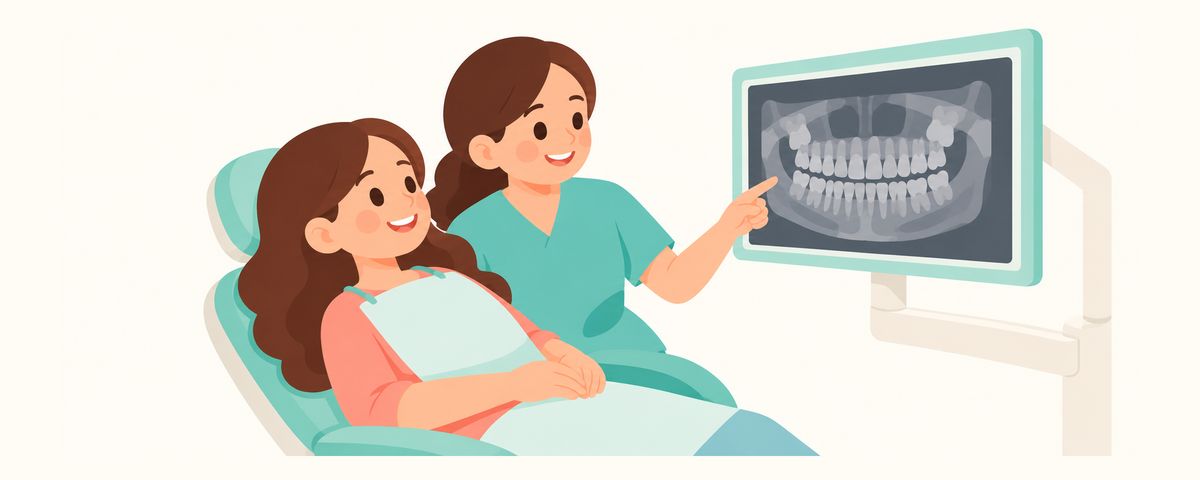
Wisdom teeth usually come into the mouth between ages 17 and 21, though some never fully come in and stay buried in the bone or gum. But they've been growing inside the jawbone long before that, so even when you can't see them, an X-ray can show their shape and position. That's why, at checkups in the mid-to-late teens, if the dentist decides it's needed after an exam and a look at your teen's growth, wisdom teeth are checked with a panoramic X-ray (one image that captures the whole jaw) or a similar image. X-rays aren't taken based on age alone. The image looks at three things:
- Number: How many are developing
- Direction: Whether they're coming up straight, or tilted, lying sideways, or buried
- Relationship to the molar in front: Whether they're pressing on the molar right in front of them
If a wisdom tooth comes in straight, meets its partner on the other jaw well, and can be reached with a toothbrush, it can be watched like any other tooth. On the other hand, if there isn't enough room and it stays buried at an angle or only partly breaks through the gum, problems are more likely. Food and bacteria get trapped under the gum flap that partly covers it, making the gum swell. And because it's hard to clean, cavities can form in the wisdom tooth or the molar in front.
Here's what to keep up at checkups
The key to managing wisdom teeth is checking ahead of time and deciding on each tooth separately. Having wisdom teeth doesn't mean they all come out.
- At a regular checkup, ask the dentist, "When would be a good time to evaluate the wisdom teeth?"
- If an X-ray was taken, have the dentist explain each wisdom tooth one by one: what shape it's in, and whether to watch it or remove it.
- If they come in straight and can be cleaned, they can be watched.
- If the plan is to watch and wait, recheck at each regular checkup. Wisdom teeth can shift position into the early 20s, and changes can happen after that too.
- If a wisdom tooth starts coming in, show your teen how to reach the toothbrush all the way to the back of the mouth. Not opening too wide actually helps the brush get farther back.
Talk about removal in cases like these:
- A tooth is buried at an angle and pressing on the molar in front
- The gum around a wisdom tooth keeps swelling and hurting
- A wisdom tooth has a cavity
When removal is needed, doing it before the roots are fully formed often means an easier recovery. But timing varies from person to person and is decided individually. Bringing up family schedules, like exam periods or sports seasons, also helps in choosing the timing.
A common mistake is putting off an X-ray the dentist has recommended because "it doesn't hurt, so it's probably fine." A buried wisdom tooth can affect the molar in front without causing any pain. On the other hand, rushing to have them all removed just because wisdom teeth are showing isn't necessarily needed either. It's best to decide by looking at both the X-ray and how things look in the mouth.
Explain it to your teen directly, too. They'll soon be going to the dentist on their own, so knowing the state of their own wisdom teeth helps them notice quickly if symptoms show up later.
Frequently asked questions
I'm worried about the radiation from the X-ray.
The radiation dose of dental X-rays is very low. Skipping a needed X-ray and finding a problem late can be the bigger loss. It's fine to ask the dentist why it's needed.
My teen's friend had all four removed. Does my teen need that too?
No. Each wisdom tooth has its own direction and amount of room, so each one is decided separately. A wisdom tooth that comes in straight and is easy to clean is sometimes left in place and watched.
Do wisdom teeth make the front teeth crooked?
Opinions are divided on this. If your teen has had orthodontic treatment or you're worried about how the front teeth are lining up, talk with your dentist.
Are wisdom teeth ever removed before they come in?
Even while still in the bone, removal can be discussed if a tooth is pressing on the molar in front or problems are expected. The timing is decided individually based on how far the roots have developed and your teen's situation.
Don't wait: see a dentist when
- The gum at the very back of the mouth is swollen and sore
- Opening the mouth is hard
- The throat hurts when swallowing food
- The gum around a wisdom tooth keeps swelling again and again
- Food often gets stuck around a wisdom tooth or the molar in front, and there's a bad smell
English ebook · Dentist Ingyoon An
A guide to the decisions behind dental care
Tooth Calendar follows dental care from pregnancy to eighteen in 78 chapters. Explore the reasons behind feeding, brushing, baby-tooth decay, sedation, and injury decisions—including what can be watched and when to seek help. Age-based contents and a topic index help you find the concern you have today.
Get these at the right time
Enter your child's birth date (or due date) in the Tooth Calendar app and these articles arrive as reminders when they matter. Free, no sign-up.
Sources
- AAOMS · Management of Third Molar Teeth (White Paper) (2016)
- ADA · Eruption Charts (2024)
The information in this article is for general educational purposes and does not replace professional dental care. Talk to a dentist about your child's condition.