 Tooth Calendar Blog
Cavities Between the Molars Can't Be Seen: Flossing Kids' Teeth and Bitewing X-Rays
Where baby molars touch, the brush can hardly reach, so cavities can hide between them. How to floss for your child, common mistakes, and why to ask about bitewing X-rays.
At a glance
- Cavities between touching molars can't be seen
- Floss once a day between the molars, and you do it for now
- Ask about bitewing X-rays at checkups
Many parents are surprised when they brush well, the teeth look fine, and then the dentist says, "There's a cavity between the molars." The space between the molars is a spot the toothbrush can't reach and the eye can't see. Here's why, and how you can protect it at home.
Where molars touch, the brush can't reach
All 20 baby teeth usually come in between ages 2 and 3 (around 24 to 33 months). Where the molars press snugly together, it's hard for a toothbrush to reach. Toothbrush bristles can't get into these contact surfaces. No matter how hard you brush, food and plaque stuck between them stay put.
The problem is that a cavity forming there can't be seen from the outside. It starts on the touching surface and spreads into the tooth, so from above, the tooth looks fine. By the time you see a hole or your child says it hurts, it has often gone quite far. That's even more true for baby teeth, which have a thin outer layer, so cavities spread fast. That's why cavities between the molars are often found from around age four.
So at this age, two things are needed. At home, floss to clean the touching surfaces. At the dentist, when needed, bitewing X-rays check the places you can't see.
Once a day, you do the flossing
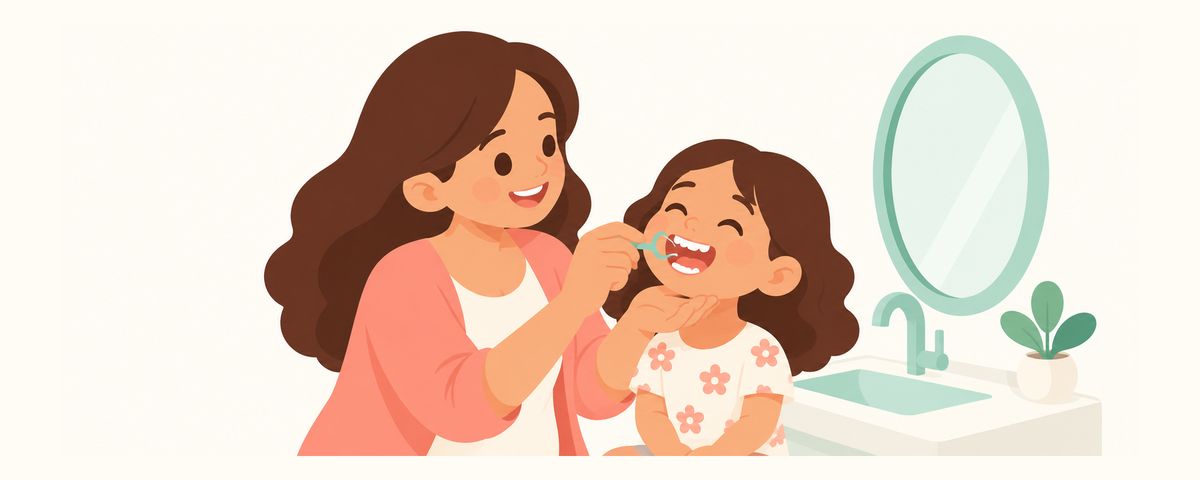
Floss between the molars once a day. Kids this age don't have the hand skills to do it well on their own, so a parent should do it. Pairing it with bedtime brushing makes it easier to turn into a habit. Flossing before or after brushing is fine, as long as you do it carefully.
- Lay your child in your lap, or stand behind your child and let their head lean against your body.
- A floss pick with a handle (Y-shaped) is easier to use in a small mouth.
- Place the floss between the teeth and gently ease it in with a back-and-forth motion. Don't snap it down onto the gum.
- Near the gum, curve the floss against one tooth and sweep it up and down, then do the same on the neighboring tooth.
- Work through the spaces between the molars in turn: top and bottom, left and right.
After sticky snacks, have your child rinse with water. For the first few days, your child may find it strange, or the gums may bleed a little. Go gently and keep at it, and it gets easier. Rather than trying to do every space right from the start, do as much as your child can handle and keep the same order every day. When you're done, a quick "Teeth-cleaning crew, done for today!" helps your child push back less.
A common mistake is putting it off because "they're still too little for floss." If the molars are touching and you haven't started flossing yet, now's the time. Another is forcing the floss in hard. Flossing shouldn't hurt. If your child says it hurts, you're pressing too hard.
Frequently asked questions
What is a bitewing X-ray?
It's a small X-ray where your child gently bites on a small film or sensor while the back teeth are photographed. It shows the spaces between the molars and the inside of the teeth, so it's used to find cavities you can't see.
Is the radiation okay for my child?
The radiation dose of a bitewing is very low. Whether and how often to take them is decided by the dentist based on cavity risk. Current guidance says lead aprons and thyroid collars are not routinely needed, though some offices still use them.
Do we need to floss if there are gaps between the molars?
If there's plenty of space, the brush can reach and you can see it, so it's less urgent. But if food gets stuck, floss it out, and floss every day wherever the molars touch.
Can't a good rinse with water replace flossing?
Rinsing with water helps clear out sticky bits of food. But plaque stuck to the touching surfaces won't come off with rinsing alone, so floss is still needed.
When will my child be able to floss on their own?
It takes a fairly long time, since hand skills need to develop enough. Until then, do it for your child. If they want to try, let them, then finish the job yourself.
When to see a dentist
- Food often gets stuck between the molars
- Your child seems to hurt when chewing or chews only on one side
- The same spot bleeds every time you floss and it doesn't get better
- The space between the molars looks darkish
- You haven't yet asked at a checkup whether bitewing X-rays are needed
English ebook · Dentist Ingyoon An
A guide to the decisions behind dental care
Tooth Calendar follows dental care from pregnancy to eighteen in 78 chapters. Explore the reasons behind feeding, brushing, baby-tooth decay, sedation, and injury decisions—including what can be watched and when to seek help. Age-based contents and a topic index help you find the concern you have today.
Get these at the right time
Enter your child's birth date (or due date) in the Tooth Calendar app and these articles arrive as reminders when they matter. Free, no sign-up.
Sources
The information in this article is for general educational purposes and does not replace professional dental care. Talk to a dentist about your child's condition.